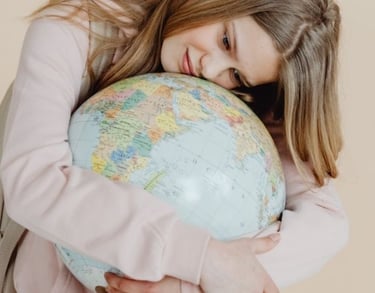
Support for our TCKs
Children are not naturally resilient. To have resilient TCKs we need to intentionally nurture and care for our globally mobile kids.
Supporting our TCKs
The two main reasons missionaries leave the field are team conflict and family problems. 78% of missionaries who leave the field do so for reasons that could be prevented or avoided.
How much attention do we give to children on our teams? How can we improve in this?
A story I recently heard from a TCK said that on Sundays, when the whole team gathered for their meeting to worship, read, and pray, the children were left on their own, often with the older kids or teenagers taking care of the younger ones. There was no meeting for them, no teaching or activities suited to their age or needs.
Their needs are often overlooked by mission agencies, by the sending church, and even by their own families, both on the mission field and off.
“It is a myth that children are naturally resilient. Resilience must be built, nurtured, and cared for.” — Lauren Wells
But let’s take a step back and begin by defining what a TCK is. A “Third Culture Kid” (TCK) is a person who has spent a significant part of their first 18 years outside the passport culture of at least one of their parents. A TCK often builds relationships with all the cultures involved, without fully belonging to any of them. Although elements of each culture may be integrated into the TCK’s life experience, their sense of belonging is often connected to others with a similar background. To be defined as a TCK, a person must live in another culture during their developmental years (ages 0–18). The cross-cultural experience takes place during the years when a child’s sense of identity, relationships with others, and worldview are being formed in the most fundamental ways.
TCKs grow up in a neither/nor world. It is neither fully the world of their parents’ culture(s), nor fully the world of the culture(s) in which they were raised. However, it is incorrect to think that this “neither/nor” world is simply a mixture of the different cultures they experience. A TCK often builds relationships with all the cultures involved, without fully belonging to any of them. This lack of full belonging is what creates the feeling of belonging everywhere and nowhere at the same time. One of the paradoxes of the TCK experience is that their sense of belonging is often found in connection with others who share a similar background. Although there are differences among TCKs in ethnicity, culture, and the place where they were born and/or raised, the shared feelings and experiences far outweigh the differences.
Now that we have better defined who TCKs are and described how important it is for them to receive the support and understanding they need to thrive on the field, let us try to understand how we can better support this important part of our teams.
TCKs are individuals with unique and precious value. They are people with needs, crises, emotions, challenges, and talents to contribute. When there is so much to do, it is easy to focus on the work that needs to be accomplished, but it is important to remember that children and teenagers are people and an essential part of our teams.
Cultural humility begins at home. Critical observation and the ability to think without judging can be practiced while still living in one’s own culture. Asking questions and remaining curious about other cultures is a fundamental skill. Understanding and accepting that there is not only one way of doing or thinking—just because our culture teaches it—helps us adapt. Practicing gratitude is a powerful tool for recognizing the good around us. There are many ways to introduce the habit of gratitude into our families. Helping our children—and ourselves—to see the good both in the culture we have left and in the one where we now live helps us avoid focusing only on what we miss or what feels different.
Children need space to ask questions and seek reassurance, even about things that may seem obvious to us. This may seem self-evident, yet a child who is removed from a safe place and taken to an unfamiliar one will first ask questions about the everyday aspects of life: What will we eat? What will we wear? Will we have a house? Can I bring my…? When parents give space for questions and concerns, the child feels acknowledged and considered.
Children need to feel protected. In this new environment, there will be difficulties and challenges, both perceived and real. Adults do not always realize how stressful some cross-cultural situations can initially be for their children. When children feel uncomfortable, parents can carefully listen to their concerns and the reasons behind their behavior, without dismissing them as trivial.
Children need to experience a sense of belonging. Many TCKs have parents whose work is people-oriented. Sometimes a TCK may feel that their needs are less important than those of others. The greatest gift a parent can give their children is to let them know, beyond any doubt, that there is a place in the world where they are loved and unconditionally accepted, and that no one could ever replace them. That place is first and foremost the family, but it can also be partly found within the team or in a context with other TCKs.
Children need to be comforted. Communicate understanding and compassion for their felt and present needs, even if the situation cannot be changed.
Children need to feel valued. They need to feel valued in all the usual ways—through listening, a hug, and so on—but also by recognizing the unique contribution they can make to the team and to the place where you are serving.
Children need to feel heard and included in decisions. Including children in decisions that will also impact them is one way to help them feel valued.
“Often the struggles of our TCK children are not evident during childhood, especially in early childhood, so parents do not see the need to address them or even talk about them. But we know that all these challenges that arise during childhood can have long-term consequences in adulthood if they are not addressed before they become obvious problems.” (Lauren Wells)
This article is based on material from the books: "Third Culture Kids: Growing up among worlds" (Pollock, Van Reken, Pollock) and "Raising a Healthy Generation of Third Culture Kids." (Lauren Wells).